Walking Through 'Inuma: A Bird Shall Carry the Voice' Exhibition


I first heard about the opening of a contemporary art center in Kigali through friends. Shortly afterward, I began seeing images circulating on Instagram: the opening announced, brief glimpses of the space appearing without fully revealing it. I grew curious.
When the exhibition opened, seven contemporary Rwandan artists were presented together: artists from different generations, living and working in different parts of the world. Curated by Kami Gahiga, Inuma: A Bird Shall Carry the Voice brings together works by Francis Offman, Kaneza Schaal, Innocent Nkurunziza, Féline Ntabangana, Christian Nyampeta, Sanaa Gateja, and Cédric Mizero through a strong and coherent curatorial gesture. The exhibition connects these distinct practices through the notion of inuma (the bird in Kinyarwanda), understood as a figure of transmission. Drawing on Ecclesiastes 10:20, the title frames the exhibition around the idea of a voice in flight, detached from its source yet still marked by it.
The space is located near Boho in Kimihurura. From the street, a path leads downward. At the bottom, behind a long glass wall, a sculpture by Cédric Mizero welcomes the visitor. Its elegant posture, oriented outward, already suggests what lies ahead. The work does not announce itself loudly; it sets a tone, indicating that the exhibition will unfold through movement rather than immediate comprehension.

The curatorial text appears only afterward, functioning as a point of orientation rather than an explanation. It reads : Inuma: A Bird Shall Carry the Voice. These artists, connected through Rwandan lineage and working across multiple geographies, mobilize material and gesture to articulate forms of knowledge that resist disappearance. The works inhabit the threshold between the spoken and the unspoken, insisting that meaning endures even in its quietest registers.
I return to the phrase "a voice in flight, detached from its source, yet marked by it." It stays with me as I move through the exhibition.
Entering Christian Nyampeta's space feels like stepping into an atelier. In front of me, books are laid out on a table, available to be read, handled, opened. Behind me, graphite drawings appear so fragile that a single touch could erase them, even as their presence would still linger. This arrangement makes me reflect on how knowledge is presented and how it exists within its surroundings. The sketches suggest a temporality: knowledge can be altered or erased, yet traces remain.

Nearby, Francis Offman's painting hangs on the wall, accompanied by a set of books placed on the floor beneath it, closed by measuring tools (a strong choice). The tools raise questions: are the books being measured, restrained, silenced? I recall Offman's practice, in which coffee grounds permeate the surface of his paintings. Mixed with glue and primer, they form dense color fields while preventing decomposition. His meticulous, almost old-masterly process is informed by the Italian art-historical canon in which he was trained. He describes these works as "abstract paintings," though they remain deeply material and historical.
On the upper floor, relationships between works unfold gradually. Attention has been paid to spacing and to how each work enters into dialogue with the others. Everything feels considered, the result of sustained exchanges between artists, the space, and the curatorial intention.

Turning to the left, Kaneza Schaal's photographic works come into view. A sense of energy and celebration is palpable in the gestures of the bodies represented. The photographs suggest inherited knowledge and unspoken forms of understanding: ways in which gesture connects individuals to a larger community, almost as an invisible technology.

Descending the stairs, the tone of the exhibition shifts. It feels like another chapter. The space opens up, and each work is presented through a careful dialogue between architecture and artwork. The works are given room to breathe, with measured lighting that allows their material qualities and craftsmanship to emerge fully.
Sanaa Gateja's works are striking. His large-scale tapestries and wearable pieces pioneer the use of recycled materials, most notably beads made from discarded paper woven into barkcloth. The artist describes this material as both surface and spirit. Paper is no longer treated as a support, but as a substance worked from within: folded, layered, pushed until it reaches its limits. Every cut and transformation feels as a strong statement. Paper is not a surface for imagery; it is the medium itself.

From there, I move into Féline Ntabangana's room. Smaller works face a large-format piece, and as I turn from one to the other, color and movement intensify. Standing between them, I feel positioned as a witness to an exchange unfolding in space. In this dialogue between the works, I sense what the artist described during the opening as light emerging from wounds.
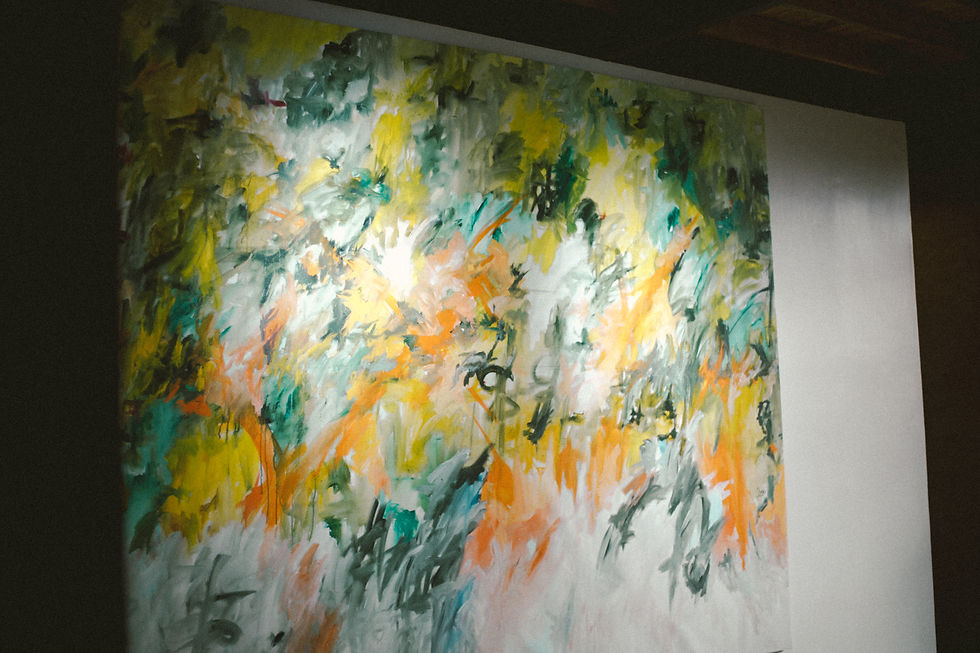
The final gallery is dedicated to Innocent Nkurunziza. Materials, forms, and media remain open and unsettled. Nothing is taken for granted. The work carries a sense of freedom built over time, shaped through sustained choices rather than immediate effect. Nkurunziza's practice engages with natural materials: earth, clay, barkcloth, mud, and plant-derived pigments. Much like Sanaa Gateja, whom Nkurunziza considers a mentor and inspiration, barkcloth becomes a primary support, processed from the bark of the Moraceae tree into a soft, malleable material.

Throughout the exhibition, I remain attentive to how knowledge is allowed to circulate. Quietly, through gesture, material, and placement, the works articulate forms of knowledge that resist disappearance. Each voice carried by the works, and the way they are positioned in the space, places the viewer in the role of a witness to a dialogue between the spoken and the unspoken, the tangible and the intangible. At moments, the presence of the Inuma (the voice of the bird) resonates like a song filled with nostalgia, recalling a place of origin.
As this first exhibition suggests, this space already feels, to me, like a place of celebration and inspiration for contemporary Rwandan art: a place that honors its sources while opening them outward, allowing voices to travel without losing their grounding.


Comments