Short Story: The Seven Sisters

In this short story set in Barbados's plantation landscape, Barbadian writer Roderick Sargeant follows a defiant African woman, seven sisters bound by sound, and a boy marked by witness as memory settles into land and body. Drawing on his broader preoccupation with ancestral memory, inherited silence, and the unseen structures of survival within the African diaspora, Sargeant blends historical fiction, speculative elements, and unsettling horror. The narrative moves from arrival to inheritance, tracing chant, restraint, and spacing as forms of resistance that outlive performance and last as continuity.

Foreword
Some arrivals do not end when the ship is emptied.A woman steps onto a foreign land carrying a rhythm that does not announce itself. It settles instead. It feeds the small decisions that keep bodies standing when they should fall. Nothing follows her immediately, but what comes next takes time.
Years later, the land begins to answer in a pattern.
Seven figures appear across these pages. They move with a familiarity that was never explained to them. They know how to stand without crowding and how to leave without breaking what holds. They share no single voice, yet their timing is exact.
This book is not concerned with lineage in the way records prefer. It listens for something older. A transmission that passes through hands, breath, and restraint. A way of surviving that teaches others how to survive better.
Read with attention because what connects these stories is not said aloud.It was never meant to be. Chapter One: The Drum Priestess
When she was brought to Barbados, she did not arrive screaming.She came off the ship defiant, carried by something that refused to kneel.

Her body bore the marks they meant as instruction. Skin written over with the grammar of the whip, yet nothing in her posture asked permission. She stepped onto the dock as if the ground had been waiting for her weight. Power had not left her. It had been gathered.
Her eyes did not dart or plead; they measured. She looked the way women look when they intend to survive and remember everything. She understood immediately that this island listened differently.
The drum had not crossed with her. That grief came later, quiet and heavy as wet cloth. But rhythm had. It lived in her step, in the pause before she answered questions meant to humiliate and in the way her breath fell into patterns even while bent under weight.
On the plantation, they set her to work in the boiling house where the heat there was constant and merciless. Sugar screamed as it changed. Men broke under it and the women learned new ways to disappear inside themselves.
She did neither.

At night, in the quarters, others spoke to survive. She listened to survive longer. She learned the island’s tones. Limestone groans and cane whispers.
The spirits followed her, confused at first. Barbados was not their place. But spirits recognize continuity. They recognized her patience. They gathered in the hush around her sleeping mat, drawn to the steadiness she carried like a low fire.

She never called to them. Calling was dangerous here.
Instead, she remembered them into being.
When a child fell sick, she sat nearby and breathed slowly, letting the room find her rhythm. When a woman’s grief swelled too large, she placed a hand on her and stayed until the body remembered how to hold itself.

They noticed her eventually. They always do. Not because she rebelled, but because things did not break the way they were supposed to when she was near. People healed wrong injuries and nights passed without screams they had come to expect.
She was warned, watched and adjusted. Power learned in chains does not announce itself. It hides in usefulness. In being needed just enough to be spared.
Years later, when a man arrived who spoke to gods through stretched hide and remembered Africa with his whole chest, she recognized him before he ever touched a drum. Not by sound but by the silence that leaned toward him.
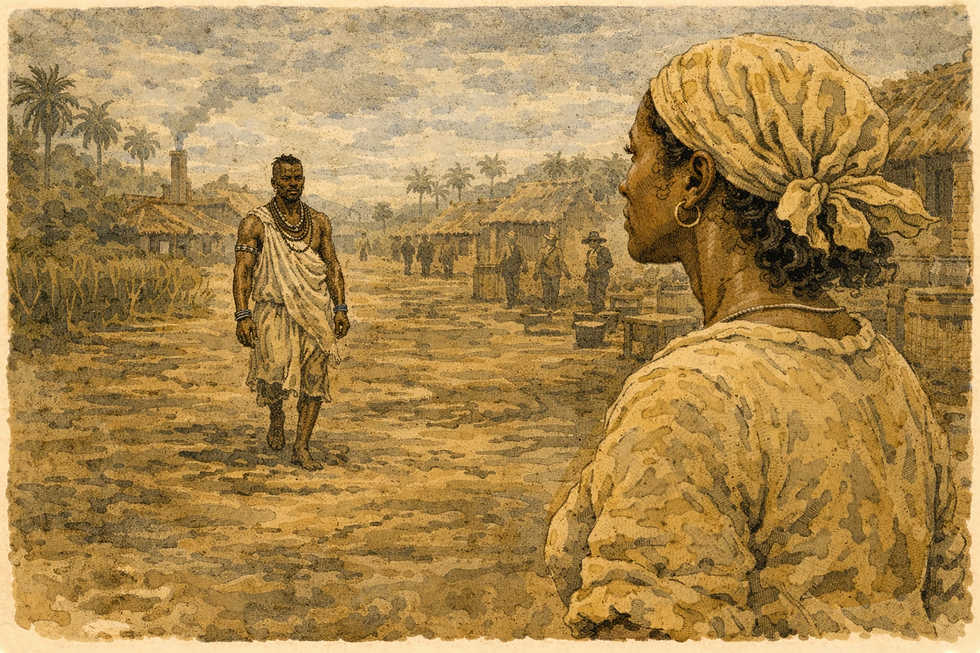
And when they stood together, drum and waiting, rhythm and restraint, the island shifted its weight. Barbados had claimed her body. But her listening had already claimed Barbados.

Chapter Two: Chant of the Seven
They were seven.
Seven sisters, each arriving one dawn after the other, as if the womb itself had learned sequence. In the same field with the same breath passed down like a baton that could not afford to be dropped.
The overseer wrote their births as coincidence, but the land did not.
They worked the same rows, not because they were assigned, but because separation broke the timing.

When one was moved, the cane leaned. When one fell sick, the birds went quiet. The fields noticed the disruption before the men did.

They did not sing to survive. They chanted to align. It started low. So low it sounded like breath leaking from tired mouths. It wasn’t a melody. There were no words anyone could accuse. It was a hum that sat between syllables, between steps, between the lift and fall of the cutlass. The chant was not carried by sound. It was carried by interval.

One sister began. The next entered one breath later. The third followed on the pause.
They learned early that power lives in spacing. The chant was built to move under command. When they were watched, it hid in rhythm. When they were beaten, it slid into silence without breaking. When night came, it reassembled itself inside their ribs, exact, waiting.

They never spoke of escape. Escape was too small a word. What they were building required precision. The chant taught the body how to loosen without collapsing. It taught the feet how to walk without leaving urgency behind. It taught fear how to step aside without announcing its departure.
The fields listened. Cane is good at holding sound and better at holding memory. Each stalk bent a fraction too early. Each row learned the pattern and began to repeat it after they passed. The land took the chant and spread it wider than seven mouths ever could.

When they left, they walked. Not together. Together would have broken the spell. One sister rose, then the next. Each a day apart in breath, even in departure. By the time the seventh stood, the first was already thinning into the dark, her rhythm still audible through the soil.

The dogs did not follow, and the whips did not land.
The men slept badly and woke confused, unable to say what felt wrong. By morning, the fields would not open. The cane stood too tight. Rows refused alignment, tools slipped and sound behaved strangely. The chant had inverted itself. What once allowed survival now denied control.

The sisters were never caught. Not because they hid well, but because they unthreaded.
They stepped out of the count the island had been using. Even now, there are places where people feel their throats tighten for no reason. Where walking slows without instruction. Where seven steps feel necessary, even when no one remembers why.
That is not haunting, that is inheritance completing itself. The sisters did not leave the island, they taught it how to refuse. Chapter Three: The Day the Field Watched
Darkness.

Darkness was the first thing he saw when the whip touched his back. Not the dark of night or of sleep. This was a closing. A door drawn shut behind the eyes. Silence followed it, thick and immediate, the kind that presses against the ears until thought itself grows afraid to speak.
He did not scream. Not because he was brave, but because something older than pain had risen up and taken his breath with it.
By the fourth strike, the world loosened. Light leaked back in around the edges of his vision, blurred and shaking, like dawn seen through water. The yard swam and the cane stood crooked. Sound returned in pieces. A bird cutting the air, the distant hiss of boiling vats, his own heart hammering too fast for a body his size.

That was when he saw them. Seven women stood at the far edge of the field, where the ground dipped and the cane no longer grew straight. They were not close, yet he knew they were watching him. Not with pity but with attention.
They stood shoulder to shoulder against the darkening green, hair bound, faces calm in a way the living rarely manage. He did not know their names, but something in his chest recognized them, the way a body recognizes water before thirst has words.
Behind them, the world was wrong. It was not a man or a beast.
It was an absence shaped like intention. The air behind the women bent inward, folding around a blackness that did not reflect light so much as drank it. Long limbs unfolded from it, jointed where joints should not be, moving slowly, deliberately, as if testing the rules of this place. It did not step forward, it did not need to. It waited, stretched thin between moments, patient as rot.

The boy tried to look away but he couldn’t. One of the women lifted her hand, just slightly. Not a warning or a command, but a reminder. Another met his eyes and gave the smallest nod; the kind elders give children when something must be endured but not named.
The thing behind them shuddered, its shape slipping, correcting itself, like a thought struggling to become real.
He understood then, without being told. The whip was not the worst thing here. The pain passed but this did not.
The sisters stood between him and that hunger, not blocking it, but holding its attention. As if saying, not yet. As if saying, this one is still learning how to breathe.
When the overseer’s shadow fell over him again, the field was empty. Cane, sky and sweat-stung earth. The women were gone and wrongness with them.

But something had been placed inside him.
Witness.
That night, as he lay on the dirt floor with his back burning and his teeth clenched against sound, he felt it settle. A low, steady heat beneath the pain. Like an ember buried deep where the whip could not reach.

Darkness returned. This time, it did not close in. It waited with him. Epilogue
The island did not mark the end.It never does.
What was placed here did not leave with footsteps or ships or names scratched into ledgers. It stayed in the places people stop without knowing why. In the pauses that arrive uninvited. In the way bodies sometimes refuse when told to break.
The woman is long gone. The boy grows, or does not.
The seven are spoken of only when someone remembers to count carefully.
But the pattern remains. Fields still tighten at odd moments. Certain paths slow the walk. Some silences feel deliberate, as if held by many hands at once. People mistake this for unease. They call it superstition. They do not know they are moving inside a lesson that learned how to survive them.
Nothing here seeks revenge. Nothing needs to.
What endures has learned restraint. It knows how to wait. It knows how to pass from breath to breath without being owned.
This is not a haunting, that is a continuation.
And it is still counting.


Comments