#Kwibuka32: How Our Past Initiative Brings the Youth Into the Heart of Commemoration

Updated: May 2
Every year, Rwanda returns to April. Through #Kwibuka32, the annual commemoration of the 1994 Genocide against the Tutsi is observed across the country. It is both collective grief and a set of questions, amongst which one continues to surface: how do you carry this together across a generation that did not live it, in a country where nearly 70% of the population was born after the genocide? Every year on April 9, Our Past offers one way in, and each year, the crowd grows. This year, it reached 12,000 people.

From Sonatube, past Niboye, past Kicukiro Centre, all the way up to Gahanga, Kicukiro runs on noise. It always has. Over the years, it has been in a constant state of becoming. A full facelift, if your memory goes back even a little. A lot came down to make room. The bright yellow Halleluia Boutique, yellow as it gets. Gone. Other landmarks too. Went down. But the road gained too. A flyover bridge went up. More lanes carved out of the road. Traffic lights. Zebra crossings. Wider road, same traffic. It never thinned.
That evening, Kicukiro was still very much itself. The motorbikes. The cars. The buses. The trucks. Just without the horns. Out the window, the familiar stretch, the bronze dancers at the roundabout, the gorilla outside Silverback Mall, Simba, the flyover bridge with its steady stream of cars coming down, Noblezza. The cab kept climbing. The crowd thickened. I stepped out, camera bag on my back. Thousands of people. Mostly in black. None of them talking. All you could hear was the hum of engines. The kind of silence that absorbs you before you realise you've stepped into it. I let it carry me in. Somewhere in that crowd was Christian Intwali, moving up and down the hill but still taking the time to greet people. You wouldn't think he had a spare moment, with an evening of that scale to hold.
I first met Christian years ago, not long after I moved to Rwanda in 2014. By then, he had already started Our Past three years prior, and it had been growing ever since. More recently, I would see him working from cafés, always surrounded by people. Laptop open, glasses on, people coming in and out. Bits of conversation you'd half-hear from the next table. A survivor's house to renovate. An activity to organise. Always something next. Somewhere along the way, the nickname "manager" stuck. He does look like a manager. The kind where kindness leads first.

Passed from Hand to Hand
Our Past is the kind of organisation that turns up, sleeves rolled up. Every April 9, they hold their flagship commemoration, a gathering that has grown into one of the most attended of its kind in Kigali. But what they do the rest of the year is just as much a part of who they are. That January gave me a front row seat to exactly that. One of their Umuganda days, the kind of collective work Rwanda has always known. Connected to one of their recurring commitments. Renovating a survivor's house. The one that January was in Ndera. Something you could see, touch, live in. That is Our Past at its most itself.
I had decided to join, partly to cover it for Imigani, but mostly to see it for myself. We met early, around 7am, at an SP station. Petrol smell, early light, people still waking up. Some had hats, some sunglasses, some had arrived in full workout gear. On the bus, someone at the back had a speaker going. People were singing along, those who knew each other already loud with it. It felt less like a mobilisation and more like friends heading out of the city together, except with shovels waiting at the other end.
Once we arrived in Ndera, we walked toward the house. It was already partly opened up, roof gone, the structure open to the sky. We were one part of a longer process. The rest would be funded through donations. That morning, the site came alive. People picked up what was there. Shovels, wheelbarrows, stones. A line formed. Stones passed from hand to hand, wheelbarrows moved back and forth. You were not there as a visitor being shown something. You were there as someone taking part.
Watching the youth work that day, I kept coming back to the same thought. I moved to Kigali as a 27-year-old, having never lived here before. The Genocide against the Tutsi had reached me in fragments, things overheard as a child, things read and gathered over years, pieces that only connected much later. Something in them kept pulling me back to it. A generation born after, finding their footing inside something they did not live. That pull, how to be present in something you did not experience firsthand, is something close to home for me.
And so when April 9 came, I already knew I would attend.
And Then, April 9

The Kwibuka flame stood at the top of the hill as we filed in, twelve thousand of us, into Kicukiro-Nyanza. This is where, on 11 April 1994, those who had taken refuge at the former ETO Kicukiro were left behind after the UN peacekeepers withdrew. They were then massacred at Nyanza. In the years that followed, remains from across Kigali were carried here and laid to rest. More than 105,000 in all.
Built into the hillside, an amphitheatre rises in layers, concrete steps set into the grass, all of them facing down toward the stage. That evening, every step was full, people seated in layers facing down. Most of the crowd stood opposite, watching everything on the large screens behind. Among them were those who had made the trip to Ndera in January, moving through the space, organising the seating, guiding people to their places. Three months earlier they had been passing stones. Now they were holding an entire evening together.
Then It Began

Ben Inkotanyi opened, his voice reaching across the amphitheatre before the evening had fully taken hold. His voice rose into that. Angels' Voice Choir followed, soft and soothing. Through all of it, Bruce Intwali and Iliiza Karangwa held the evening together as MCs, keeping things moving, holding the space between moments.
In between came Suzanna Nyiranyamibwa's Ibuka, a song that finds its way back every year, at every commemoration. When it came in, something in the crowd stilled. People who had been shifting found themselves going still.
While the performances moved through the evening, the sky was shifting too. Two colours at once, a soft orange and a deeper blue in the clouds, uneven, almost brushed into each other.
Into that darkening, a group from Gashora Girls Academy, through Poetry Lab, came forward. Five young girls. A solemn soundtrack behind them. Their performance, titled What We Were Told Became Ours, spoke about what it means to be born after, about inheriting something you did not experience but cannot step outside of.
Issa Nsengiyumva, a survivor from Kagarama in Kicukiro, sat down to share his testimony. The crowd around me stilled. Parfine Mizero of Peace and Love Proclaimers came forward, unequivocal. On genocide denial, there is no neutral ground. Not taking a stance is taking one. And within that, a reminder that this is also our role as the youth, to carry that legacy, actively and consciously. When she stepped away, the crowd sat with it for a moment.
In the Full Dark
As the light changed, so did the weight of the evening. And into that dark, the stage was being set for the play.
Malaika Uwamahoro, a multidisciplinary artist whose work moves across theatre, music, and poetry, had performed Rhymes of Remembrance, a poetry album, at the year prior's edition. She had been asked to return, but felt that coming back with the same work would not hold. She felt that if there are that many lives, that many stories, then no single version can stand in for all of them. So the work opened outward.
A call had been put out to playwrights. Many texts were submitted. Two stood out, written by Domi Benimana and Junior Rumaga, each arriving at it independently, each having sat with the subject and produced something of their own.
What each had written was distinct. Complete in its own way. But when the two were read together, something else became visible. What one held, the other extended. What was missing in one appeared in the other. Rather than choosing between them, Malaika brought them together. A three-day workshop followed at Wonderland, moving passive poetry into something that could be acted, stitching two separate bodies of work into one piece without losing what made each of them worth keeping.
Together, the two texts became Inzibutso, a play that moves across three spaces, a room of isolation, a courtroom where God is put on trial, and an investigation room confronting perpetrators, bringing together voices of survivors, witnesses, and those responsible to explore memory, truth, and what remains unresolved.
Around forty-five people auditioned. Thirteen were chosen.
What the Stage Held
It starts in complete darkness. A voice comes through. Malaika's. Echoed and layered, pulling the dark into focus. Then the name appears on screen. Inzibutso. In orange, carried by singing voices.
A scream breaks through. A refugee opens into a monologue, her voice carrying what it means to grow up motherless in a country that was not her own. A single voice carrying what cannot yet be contained.
Boukuru's voice follows. Bari hano. They are here. Pictures of children fill the screen. A woman's voice begins calling out names, crying them almost, names of victims, one after another. Then footage rolls. Slow motion. A woman holding a baby. Leaves. Sunlight. Fragments of life, suspended in time, interrupted.
The stage stays minimal throughout. Chairs hold the actors in place, grounding them, limiting movement, keeping attention on the words. The history is what moves. Three rooms, each carrying a different register of it.
In the room of isolation, each figure carries a different fragment of what was lived. The refugee who opened the play returns, carrying what she carried before. Exile, a language not her mother's, a country that was not her own. A survivor carries the memory of small kindnesses inside enormous violence. She was hidden in banana leaves by the son of a genocide perpetrator. He brought water. He brought sweet potatoes. He chose differently from his father. A woman sits with the figure of her closest friend, someone gone but conjured back into presence, so vivid the conversation feels real. They go back together, remembering the boys they had crushes on, how close they were, how much happiness they brought each other. A final figure closes the room with a vow to never disgrace those who gave him value.

Talking with Malaika afterward, that scene stayed with her most. She said it simply: "These memories are not always about how their family members were killed, but rather how they lived together, remembering how close you were, how much happiness you brought each other." It is a small observation that holds an enormous truth. Over a million people were killed. The number is too large to hold. But a woman remembering the boys she had crushes on with her closest friend, that you can hold. The human brain cannot grieve a million people. It is not built for that scale. It can grieve one. And through one, it begins to understand what a million means. Restoring that is its own form of justice.
The courtroom is where God is put on trial. Somewhere among the audience, a white chair stands, lit. It is meant to be God. A judge and jury sit silent, their eyes on it. The judge breaks down without saying a word. Everything is addressed to that chair. Always the same questions. They are the ground on which the whole piece stands. Why did this happen. How could you let it happen. If you say you're God with all the power, then how are you using your power. Where were you.
Then the defence. A voice argues that God sent people to do the right thing, and they chose not to. If we are made in his image, the argument goes, how can forgiveness be too hard.
In the investigation room, one perpetrator has already confessed. He carries remorse and can see a future. Another has not. You can see it in him, the hesitation, the weight, as if he is already surrounded by what he has done but still unable to say it. Not yet. A woman steps forward asking for truth, asking him directly what he did to her family. She does not come with tears. She comes with strength and a specific need to know the truth, so that she can bury her family with dignity. Her words to him are simple. "Not knowing is tormenting."
Malaika's voice moves between rooms. Not to explain, but to hold. To insist that none of what has been witnessed is left behind. By the final voiceover, all three rooms are being held at once. The grief, the anger, the guilt, the tenderness. All of it carried forward together, toward something that is not yet resolution but is trying to be.

The man in pink steps forward. When asked about forgiveness, his response is Imbabazi n'urugendo. Forgiveness as a journey. The word lands in that room like something both necessary and impossible. Because how do you forgive this. And yet how do you not. The asking of it is its own violence. The withholding of it is another. What the play understands, and what that word carries, is that the genocide did not end in 1994. It continued in the silence, in the unburied, in the untold, in everything left unresolved, in everything the survivors and the perpetrators and the truth itself have had to carry since.
At the end of the monologues, one voice. We are one. And Rwanda is a paradise. Then Ish Kevin. The tone shifts but the weight stays. One question left. After all of this, is it still possible to choose how to live. The play closes without answering its own questions. It leaves them with the audience.
The questions stay. So does the ground they were asked on.
A Transmission

After the play, the space felt altered. Candles were brought out, one after another, passed through the crowd. Twelve thousand people holding light in the dark. Not a number anymore. Twelve thousand individual flames, each one a life you could look at, stand next to, feel the warmth of. Not a million. But enough to begin to feel what a million means. It echoed something from earlier, those scattered lights visible below the hill, distant and steady. Now gathered. Now held together. Now lifted by twelve thousand hands.
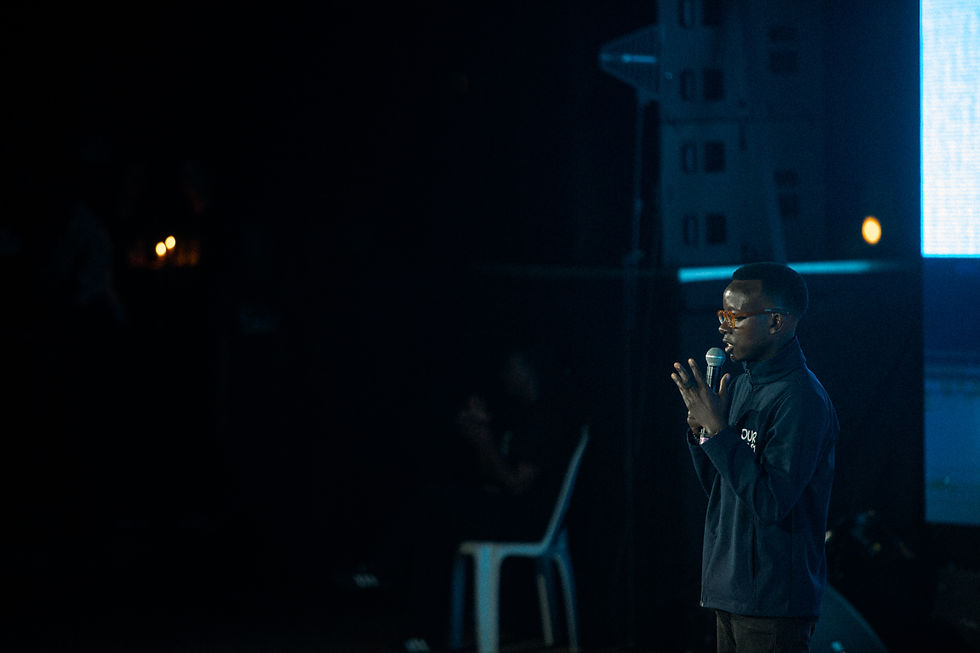
Christian Intwali stepped forward. On screen, pictures from January came up, hands at work, bodies bent in effort, passing stones at a survivor's house in Ndera. Now part of something larger. He spoke quietly, the way you do when the evening has already said most of it, before thanking everyone who had made it possible. That evening made something plain. Remembrance does not stop with those who survived it. Showing up, picking up a shovel, holding candles, sitting in the dark and listening. That is how a generation makes it its own.


Comments